The True Story of How My Mother Met Chief White Feather (and inspired a novel)
By Leonard Wibberley
First Published in The Los Angeles Times on January 28, 1952
8/9/26
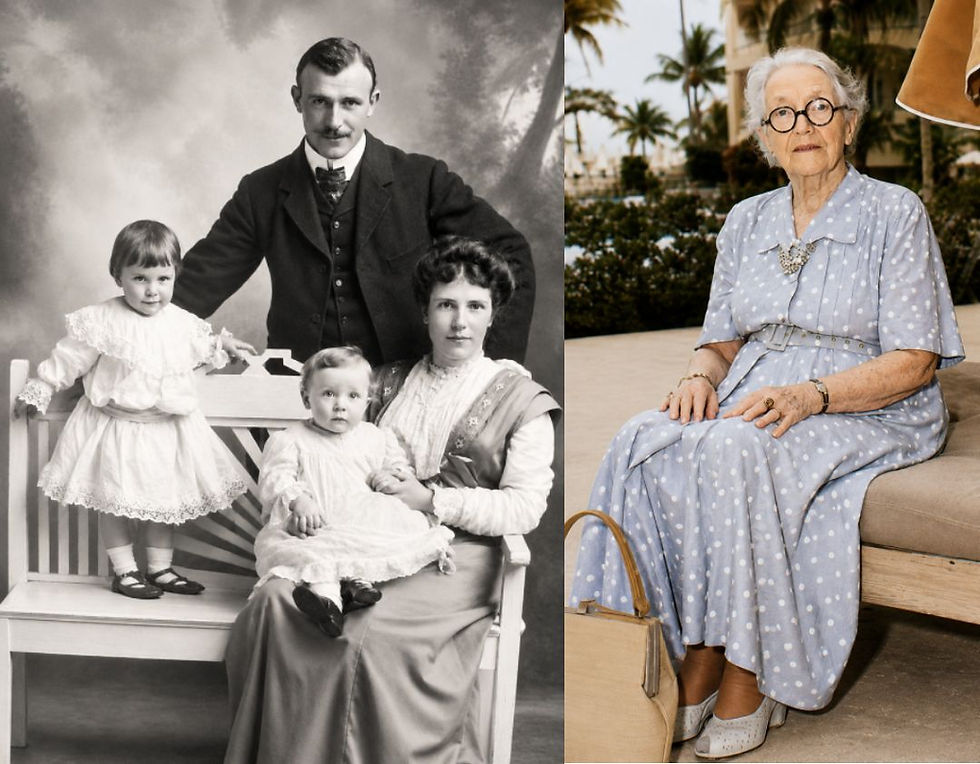
White Feather, a chief of the Algonquian Indians, who was said to have come to England as part of Pocahontas’s retinue, died somewhere in the middle of the 17th century, a “historical fact” of minor importance to me until I learned that he spent the war years in London, where he occupied himself as an air raid warden for a block of apartments on the Thames embankment not far from the Houses of Parliament.
This block of apartments is called Grenville House and in one of the flats on the top story my mother lived.
My mother has been to America only once in her life and has never met an Indian. I mention this because it is all the more surprising that she and Chief White Feather should have struck up an acquaintance at first encounter which developed into the firmest of friendships. Mother is not standoffish but nonetheless one expects a certain reserve in an elderly lady confronted by an Indian.
“He’s a very nice man,” mother said, “and I think he took quite a fancy to me the first time we met. That was in Kensington High Street. I was waiting outside of Barkers for a No. 11 bus to get to Westminster when a voice said, ‘Get into a doorway.’ Well, I WAS surprised. But I got into a doorway anyway, and would you believe it, one of those horrid airplanes came down the street chasing another and firing bullets all over the place. They were gone in a second but if I’d stayed there I’d have gone to my reward.”
At this point I took a rather big gulp of hot tea and choked on it and mother said I must be careful about getting colds on the chest as I had always been a delicate boy.
“The flowers are going to be lovely this year,” she said. “Do you know, I think they get better every year. Maybe that’s because I’m getting on. But they always seem so much fresher.”
“About this Indian,” I said. “Don’t you suppose it might have been someone standing behind you who told you to get in the doorway?”
“But there was no one standing behind me,” said mother, “so it couldn’t have been—could it?”
“Well,” I said, “maybe it was just instinct. You know, Sometimes you jump out of the way of a car or something and when you think of it afterward, you fancy you heard a voice telling you to jump. The more you think about it the more convinced you become, because you have to have a logical reason for jumping.”
“If you’ve jumped out of the way of a car that you didn’t see because somebody told you to jump, you’ve got an Indian too,” mother said. “I wonder if he knows my Indian. Mine’s named White Feather.”
I said rather pettishly that I did NOT have an Indian but mother said there really wasn’t anything to be afraid of about having one as her Indian wasn’t hostile.
“Lots of people have Indians,” mother said. “They’re really quite friendly but sometimes I think they haven’t got much sense of responsibility. Or rather they haven’t got a sense of the same kind of responsibility as we have.”
“You mean he gets you into trouble?” I asked.
“Oh, no,” said mother. “White Feather’s very considerate, It’s just that he doesn’t know the value of things—like a child.”
“Breaks vases, perhaps?”
“No, nothing like that. He just isn’t aware of all the things that can happen. For instance, one morning he woke me up about 2 o’clock and told me to get down to the shelter as there was something coming. I went around to all the neighbors and told them Chief White Feather said we’d better get into the shelter—they’d come to rely on me to warn them of anything coming, you know.
“Well, he was in such a hurry and kept insisting that I be quick that I got flurried and I went down with just my dressing gown on. We’d hardly got inside when whatever it was hit the place—it turned out to be one of those wretched flying bombs.
“When it was over, I went up to my flat and found the bomb had come through the roof and just ruined everything. What the bomb hadn’t burned the firemen had soaked. They always used too much water, and I told them so many a time but a lot of good it did.
“I was so angry with Chief White Feather that I didn’t talk to him for a week or more.”
“Angry?” I said “Goodness. I’d have thought you would be grateful.”
“Nonsense,” said mother. “He knew perfectly well that the bomb was going to blow up my apartment and burn all my clothes. Yet he let me go down to the shelter with just my nightdress and dressing gown without stopping to pick up anything. All my clothes were ruined.
“And, of course, I didn’t have a single ration coupon to get some new ones. I got some anyway because I asked the man—did he think we were fighting this war so that elderly women could walk through the streets with nothing but a dressing gown on their backs? Well, he didn’t have an answer for that, so I walked out with everything new and not a coupon given for it.”
“You mean that if Chief White Feather had had any sense of responsibility, he’d have told you to save your clothes?”
“Well, that’s what I thought at first,” mother said, “But afterward I realized that he just didn’t understand about clothes. You see, he doesn’t wear much himself.”
I think (I’m not quite sure about it) that mother blushed.
***** NOW AVAILABLE ON KINDLE, PAPERBACK, and AUDIOBOOK *****
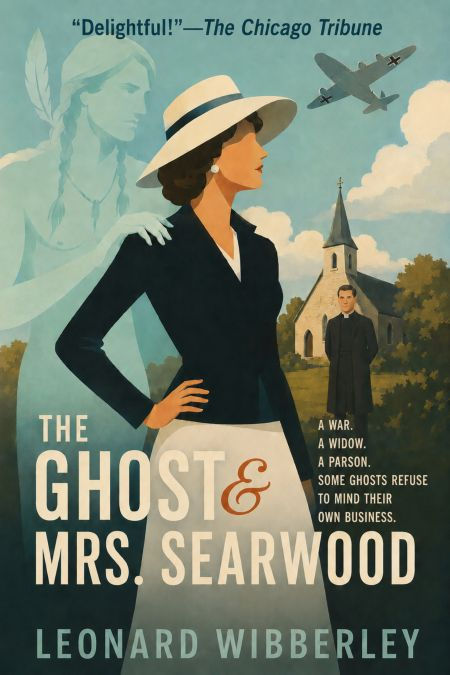
THE GHOST & MRS. SEARWOOD
(previously titled, Mrs. Searwood's Secret Weapon)
Mrs. Searwood is convinced Hitler has a personal grudge against her.
After one air raid too many, the widowed Londoner meets the last person she ever expected: the ghost of Chief White Feather, who came to England with Pocahontas three centuries earlier and has been quietly educating himself at Britain's finest universities ever since.
Wise, witty, and endlessly curious, Chief White Feather becomes Mrs. Searwood’s confidant, champion, and occasional matchmaker. When she leaves wartime London for the safety of a small English village, he follows, gently nudging her toward a life she thought widowhood had put forever out of reach.
As war reshapes England, Mrs. Searwood discovers unexpected friendship, quiet courage, and a romance she never imagined possible.
Filled with Leonard Wibberley’s signature wit and warmth, The Ghost & Mrs. Searwood is a charming tale of hope, second chances, and the comforting thought that some friendships can transcend even death.
“A light-hearted whimsy laid in wartime England.”—Kirkus Review
“Pure diversion… a chuckling fantasy… of superior inventiveness and wit.”—The Saturday Review
★★★★ “I loved it! So British and so quaint. A great quick read.”—Goodreads Review
★★★★ “Marvelous. A wartime comedy of manners.”—Goodreads Review
★★★★★ “This charming fantasy takes place in England during WWII and celebrates, discreetly and with humor, the resistance of ‘little people’ in the face of the madness of war.”—Amazon Review
Find The Ghost & Mrs. Searwood on Amazon here.
Sign up for Leonard’s newsletter at:
GrandFenwickNews and never miss one of his columns.
To read older columns, click here.


Comments